Saturday, July 2, 2011

India issues RFI for multi-role naval helicopters


India has issued a request for information for a naval multi-role helicopter (NMRH) to complement its existing fleet of Westland Sea King 42 anti-submarine warfare (ASW) helicopters.

The RFI calls for helicopters with a maximum all-up weight of between 9t and 12.5t. The NMRH, which will be expected to serve for 30 years, should have the capacity for 10% weight growth throughout its service life without hurting performance.

The navy foresees three primary roles: ASW, anti-surface warfare (ASuW), and special operations. Secondary roles include electronic intelligence, search and rescue (SAR), external cargo carrying, casualty evacuation and combat SAR.

Candidate helicopters must be able to operate from ships as small as the navy's Godavari-class frigates. They also need to be able to fit in shipboard hangars with a length of 15.5m (50.8ft), a width of 5.5m and a height of 5.3m.

"The NMRH should be a contemporary design with modern, reliable and fuel-efficient engines and fully integrated advanced avionics/weapons suite employing the latest concepts for detection, identification, classification of surface and sub-surface targets along with the ability to detect air targets," the RFI said.

It also outlines performance requirements for two variants: one focused on ASW/ASuW and the other for special operations.

For the former variant, India seeks an aircraft that can autonomously locate and destroy submarines, compile an integrated picture of the situation above and below the surface, and operate in all weather conditions.

The special operations variant needs the capability to carry unguided rockets and guns.

Possible candidates for the requirement could include the Lockheed Martin/Sikorsky MH-60R and NH Industries' NH90. The deal will require a minimum 30% offset obligation under Indian laws.

India not worried about China's aircraft carrier


China's declaration that its first-ever aircraft carrier will begin sea trials towards the year-end has caused tremors around the world. But even as it jostles for the same strategic space in the Indian Ocean region, India is not too unnerved by all the brouhaha.

For one, even if the carrier becomes ocean-worthy by 2012-2013, it will take China a few years to master the complex art of operating fighters from a moving airfield on the high seas and then converting the entire package into a potent offensive weapons platform.

India, of course, has been in the business of operating "flattops" for five decades now, commissioning as it did its first carrier INS Vikrant with its Sea Hawk jets way back in 1961. As of now, the Navy operates the 28,000-tonne INS Viraat, even though it's left with only 11 of its Sea Harrier jump-jets.

"Aircraft carriers, which can travel 600 nautical miles a day, are no doubt game-changers. But it takes a lot in terms of fleet doctrines and tactics, training and technology to operate them effectively," said a top Navy officer.

Interestingly, China has got its first carrier by refurbishing a rusting half-completed `Varyag' 67,500-tonne carrier, which was first built in the Soviet Union of 1980s and was then bought by China from Ukraine in 1998 on the pretext of running it as a floating casino.

For another, India has already launched preparations for the "integration" of MiG-29Ks, the first-ever naval supersonic fighters it's now inducting, with the 44,570-tonne INS Vikramaditya or the refitted Admiral Gorshkov it will get from Russia in early-2013.

Moreover, the 40,000-tonne indigenous aircraft carrier (IAC), being constructed at Cochin Shipyard, will finally be "launched in a few months" now after some delay to ensure it's ready by 2015 or so.

India aims to have two "carrier battle or strike groups" (CBGs), with their accompanying fighters, patrol aircraft, destroyers, submarines frigates and tankers, by 2015. Incidentally, the US has 11 CBGs to project power around the globe.

"Vikramaditya will give us serious maritime strike capabilities for the first time. With mid-air refuelling and double the combat radius of operations as well as BVR (beyond visual range) and guided anti-ship missiles, smart bombs and rockets, MiG-29Ks will provide a four-fold capability jump over Sea Harriers," said an officer.

Navy has already inducted 11 of the 45 MiG-29K fighters ordered from Russia for over $2 billion. India, of course, will now get Vikramaditya in early-2013 after agreeing to the revised refit cost of $2.33 billion after three years of bitter wrangling with Russia since the earlier agreement inked in January 2004 had earmarked only $974 million for it.

"Vikramaditya should begin sailing by the end of this year after steaming and basin trials. Extensive sea-trials will follow thereafter. Over 150 Indian officers and sailors are already in Russia for training. The next batch will go in January," he said.

Indian Navy all set to welcome INS Vikramaditya


The Indian Navy is all set to welcome the INS Vikramaditya. The navy set the ball rolling to integrate the aircraft carrier (earlier known as the Admiral Gorshkov) with its fleet as the warship, being redone at a Russian shipyard, readies to sail home in early 2013.

The integration plan was discussed at a recent meeting of naval commanders in New Delhi as some key "firsts" are associated with the ship. More than double the size of existing aircraft carrier INS Viraat, it will be the biggest warship ever to be operated by the Indian Navy. The second crucial aspect is that for the first time, the navy would be operating supersonic combat jets from the flight deck. Once it arrives, the naval fleet will have to be arranged around it, as the Vikramaditya would become the central platform.

The fleet rearrangement is also necessitated by the fact that the navy is in the middle of a modernisation drive as many warships are under construction. It is estimated that by the time the Vikramaditya joins the fleet, the navy would have added the remaining two of the state-of-the-art multirole Shivalik-class stealth frigates, the first of which has already been delivered. It would also have at least two new antisubmarine warfare corvettes. The navy will also get three new potent Talwar-class frigates, being built in Russia. In fact, close to 40 new warships are under construction at various shipyards in the country. This means that the fleet will not only grow in numbers but will also have modern warships.

India receives combat management systems for Scorpene submarines


French shipbuilder DCNS has delivered two highly sophisticated combat management systems for the first two Scorpene submarines being built in India. The system forms the "brain" of the vessel.

DCNS India Managing Director Bernard Buisson told India Strategic defence journal that
both the systems had been delivered to Mazagon Docks Ltd. (MDL), which was in the process of integrating the first one at present. There are about 20 to 25 French engineers
assisting in technology transfer and work at MDL was maturing to mutual satisfaction.

The first Scorpene submarine, under the Indian Navy's Project 75, will be launched end-
2013 and commissioned in 2015. The second one would be a year later. Buisson said that MDL was actually doing some work, at different levels, regarding all the six submarines under the project and that all the six submarines would be delivered by 2018.

MDL had built the hulls of first and second submarines, and begun work on the hulls of
third and fourth submarines. Simultaneously, other systems were being tested and installed on them progressively.

Buisson said that DCNS has had technical discussions with the Indian Navy on installing

air independent propulsion (AIP) systems on board the last two submarines. There would be
a cost, but the AIP would increase the submergence of the vessels by three to four times,
thereby making them hidden and more lethal.

The company was awaiting the navy's response, as well as an order for the new line of six
or more submarines under Project 75-I, all of which would be equipped with he AIP systems. DCNS had already responded to the Indian Navy's request for information (RfI) in this regard.

Buisson said that DCNS' AIP system was based on the MESMA steam AIP used on board all the French nuclear submarines. France as only nuclear-powered submarines and accordingly,
proven for technology, he added.

Asked about local participation in the Scorpene project, Buisson said that DCNS was also
talking to private shipyards as per the new Defence Procurement Procedure (DPP) and offset requirements.

"We are also in the process of finalizing the selection of our industrial partners for
indigenization of MPM (Mazagon Purchased Materials from other companies) items," he said.

MPM items include pumps, valves, air conditioning equipment and various sub-systems.

Pilots Should fly British naval Rafale on Charles de Gaulle


According to British newspapers, five pilots of the Royal Navy are taking French lessons Already with this goal.

Pilots 'top gun' Royal Navy are Being forced to take French lessons, so flying Rafale fighters from the aircraft carrier Charles de Gaulle , The French Navy. The information is the British newspapers The Telegraph and Daily Mail.

Pilots Royal Navy Should Communicate With Their French counterparts Marine Nationale Both the air and aboard Charles de Gaulle , In joint training with the Rafale, while waiting for delivery of new ITS F-35, Which Should not be ready before 2020.

The first five British naval pilots, a total that is expected to reach thirty, are Already receiving French lessons in Interarmées College of Defense (CID) in Paris. Will be 16 weeks learning the language, before Beginning the training period of three years in the embarked air group Charles de Gaulle, in order to gain experience in the Rafale, Whose best riders, or 'top guns' are known as "les chevaliers du ciel' - Knights of the sky.

A senior Royal Navy officer said, 'Who Say That would more than 200 years after the Battle of Trafalgar, we would be the French to train Asking our naval fighter pilots? Our relationship with the French was always a little tense, then this is a great test of Cooperation. For decades. our perception of the French has always Been That They Arrive When the battle is over. Now David Cameron (British Prime Minister) forced us to join forces, take French lessons, and eat your food. "

Speaking of food, instead of bacon and eggs for breakfast the British ships, the British will have to get used to coffee with croissants. The quality of the food is, Should this not be a problem: Those who have embarked on French ships That states meals on board are far better served in the British ships, with dinner Being the highlight of each day. Cheeses and wines are fine Also on the menu, the Latter Replacing the beer and vermouth and gin and tonic traditionally eaten by officers britâncos gaps in service.

The UK has already sent pilots to train with the U.S. Navy (U.S. Navy), but is the first time the French That Were Asked to train British naval pilots.

According to Capt.. Jock Alexander, the British fleet will need to have a group of Experienced naval fighter pilots before the Royal Navy ITS receives two new large aircraft carrier, the end of this decade.

According to a spokesman for the Ministry of Defence United Kingdom, 'the relationship with France is of Strategic Importance, and discussions are underway for Royal Navy personnel is based on Charles de Gaulle The part of the bilateral agreement Between the two countries. This will allow us to keep our skills and help the upper Develop Ability to attack from aircraft carrier in the future. "

China aircraft carrier confirmed by general


China's aircraft carrier is seen under construction in Dalian, Liaoning province (April 2011) (above) and on Google Maps

The 300m (990ft) carrier, under construction in Dalian, is thought to be nearly finished

The head of China's General Staff of the People's Liberation Army (PLA) has confirmed that China's first aircraft carrier is under construction.

Gen Chen Bingde refused to say when the carrier - a remodelled Soviet-era vessel, the Varyag - would be ready.

A member of his staff said the carrier would pose no threat to other nations.

The 300m (990ft) carrier, which is being built in the north-east port of Dalian, has been one of China's worst-kept secrets, analysts say.

Gen Chen made his comments to the Chinese-language Hong Kong Commercial Daily newspaper.
Symbol of power

The PLA - the largest army in the world - is hugely secretive about its defence programme.

The carrier was constructed in the 1980s for the Soviet navy but was never completed. When the Soviet Union collapsed, the rusting hull of the Varyag sat in dockyards in Ukraine.
“Start Quote

The giant, grey hulk of China's newest warship, 60,000 tonnes of steel, sits at a dockside in the port of Dalian, almost ready to set sail”

A Chinese company with links to the PLA bought the Varyag claiming it wanted to turn it into a floating casino in Macau.

The carrier is thought to be nearly finished, and is expected to begin sea trials later this year.

But the BBC's Michael Bristow in Beijing says that does not mean it will then be ready to undertake operational duties.
Size comparison of world aircraft carriers. List of aircraft carriers by country: US 11, Itay 2, France 1, India 1, Spain 1, UK 1, Russia 1, Brazil 1, Thailand 1

Learning how to operate it - and fly planes off it - will take a few more years to master, our correspondent says.

Lt Gen Qi Jianguo, assistant chief of the general staff, told the Hong Kong Commercial Daily that even after the aircraft carrier was deployed, it would "definitely not sail to other countries' territorial waters".

"All of the great nations in the world own aircraft carriers - they are symbols of a great nation," he was quoted as saying.

Lt Gen Qi said China had always followed a "defensive" principle for its military strategy.

"It would have been better for us if we acted sooner in understanding the oceans and mapping out our blue-water capabilities earlier.

"We are now facing heavy pressure in the oceans whether in the South China Sea, East China Sea, Yellow Sea or the Taiwan Straits," he said.

China is engaged in maritime border disputes with several countries - including Vietnam and the Philippines.

The US, which has 11 fully-capable carrier strike groups, has also expressed concern about its rising naval ambitions.

The PLA has invested heavily in submarines. It is believed to be close to deploying the world's first "carrier-killer" ballistic missile designed to sink aircraft carriers while they are manoeuvring at sea up to 1,500km offshore, and it is building its own stealth fighter aircraft along with advanced carrier-based aircraft built from Russian designs.

All of these can target US bases, US ships and US carriers in Asia.

India is another emerging power pursuing a similar path - with an ex-Soviet carrier being modified for the Indian Navy, and work already under way on a first home-built vessel as well.

Over time, these developments will affect the maritime balance of power in Asia, says the BBC's defence and security correspondent Nick Childs.

China says other countries have nothing to fear, but its recent assertive diplomatic and military muscle-flexing has created waves in the region, he says.

Saturday, June 4, 2011

Indian Navy gets new MiG-29K carrier-borne fighters


Indian naval aviation has acquired new teeth with induction of nine MiG-29K carrier-borne fighter jets from Russia with an extended range of 3,000 kms and capable of firing air-to-air and air-to-sea missiles.

The Russian MiG Aircraft Corporation has delivered the second batch of five MiG-29K fighter jets to the navy, to add to its four, for which it has raised the new "Black Panthers" squadron.

India along with Russia, the manufacturer of the naval fighter, are the only countries to have acquired these fighters, which will be deployed on the INS Vikramaditya (former Gorshkov) aircraft carrier, under re-fit in Russia.

The newly acquired Russian carrier-operated MiGs are considered to be far superior to Indian Navy's current Sea harrier jump jets.

Under the Gorshkov aircraft deal inked between the two countries in 2004, Russia is to supply 12 single-seater MiG-29K fighters and four two-seater MiG-29KUB trainer-cum-combat jets.

According to a MiG release first of four MiG-29Ks and MiG-29KUBs delivered to India have been formally inducted by the Indian Navy's "Black Panthers" squadron in February 2010.

MiG Corporation has also delivered flight simulator and other technical equipment to the Indian Navy.

In March 2010, Russia and India signed another USD 1.5 billion contract on the supplies of 29 additional MiG-29K Fulcrum-D carrier-based fighter jets and the deliveries are scheduled to commence next year, about the time Moscow is expected to deliver retrofitted Gorshkov aircraft carrier after serious delays.

SAAB to bid for Indian Navy MRMR tender

Swedish defense and aerospace company SAAB is planning to offer its SAAB 2000 aircraft to the Indian Navy when it issues a Request For Proposal (RFP) for Medium Range Maritime Reconnaissance (MRMR) aircraft in the next few months.

The Indian Navy currently operates the Russian Tu-142 Bear and IL-38 aircraft, in addition to Dornier aircraft. It has also ordered eight P-8I Long Range Maritime Reconnaissance (LRMR) aircraft and is expected to buy an additional four.

The aircraft is built by US aviation company Boeing, which is planning to pitch a medium range ‘diet’ P-8 for the Indian Navy’s MRMR tender.

While the SAAB 2000 is being offered with the RBS-15 Anti Ship Missile and a fifth generation Selex AESA radar, what is also interesting is that SAAB is offering re-manufactured aircraft, since the company ceased production of the aircraft in 1999.

“We will take an existing SAAB 2000. We will re-manufacture it and build it up. So it will be ground zero flying hours. We will have all the warranties. We will have 35,000 flying hours. It will have 25 years of support,” said Tommy Hultin, SAAB’s Business Development Director for the program.

Hultin also says the Harpoon missile manufactured by Boeing, which India is already planning to acquire for the Indian Air Force (IAF) Jaguar and the P-8I aircraft, can also be configured on the SAAB 2000, which he points out, is one of the fastest turboprop aircraft flying.

SAAB's offer

The baseline SAAB 2000

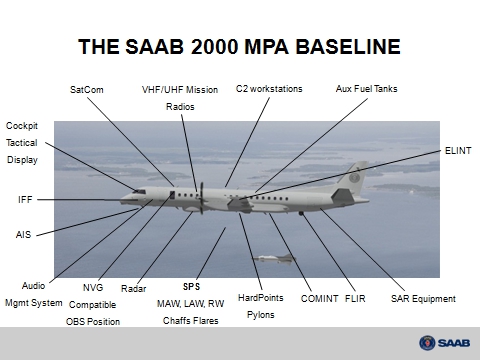
Radar: Selex Active Electronically Scanned Array (AESA) Maritime Surveillance Radar with long range search of 200 nautical miles. The interrogator functions of the Identification Friend-or-Foe (IFF) capability can be customized. The radar is paired with a Saab R4A AIS transponder receiver/transmitter system that marks maritime activity with an encrypted data link.

Electro-Optic (HDTV) and Thermal Imager sensors: For close range detection, identification and recording of surface objects and activities.

Growth options on the SAAB 2000

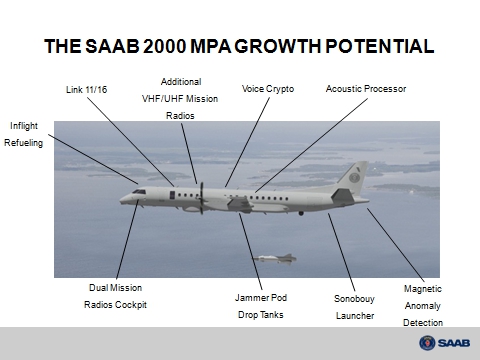
ELINT: Capable of intercepting and collect intelligence information consisting of detailed information of e.g. complex emitters active signal components, the relationship and the dynamics between active signal components.

ESM system: Automatically identifies RF (Radio Frequency) signal sources and Direction Finding of RF signal sources.

Specifications of the SAAB 2000

SPS system: Radar warning receivers, missile approach warning sensors, laser warning sensors as well as chaff and flare dispensers for self protection.

COMINT system: Enhances SIGINT capability by complementing the baseline ELINT system. Includes Direction Finder function and an Intercept System.

Cabin layout of the SAAB 2000

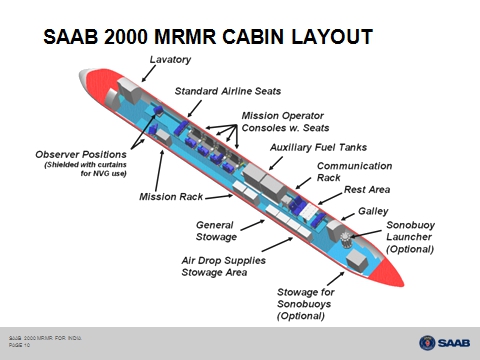
Command & Control (C2) system: Integrates and assists in controlling mission sensors and provides the user interface to mission operators, via four (4) workstations installed side-by-side in the cabin facing starboard, and to the pilots via a dedicated tactical display. The workstations also provide access to the mission communication system.

FLIR: Forward Looking Infra Red which can be used for identification of vessels. While performance depends on on environmental conditions such as fog, sea-state, salt percentage, it can typically be used within a range of 5-10 nautical miles.

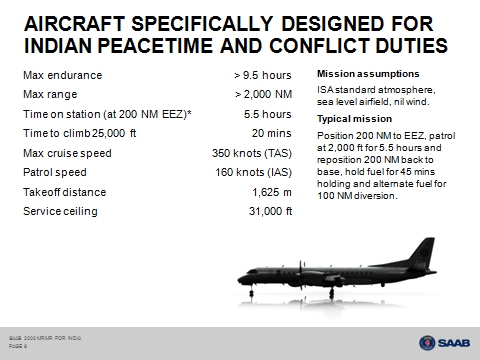
SAAB says the aircraft can operate from high altitude airfields, ‘taking off with maximum load and fuel even at very hot temperatures’. With a cruising speed of 350 knots, it can climb to an altitude of 20,000 ft in 10 minutes and reach an operating area 1,000 nautical miles away within three hours. It can maintain position on a single engine even at a height of 20,000 feet.

The aircraft is said to be able to carry out a mission covering 200 nautical miles Exclusive Economic Zone (EEZ) for 5.5 hours at an altitude of 2,000 ft, or longer patrol times at higher altitudes up to 31000 feet.


Sponsors